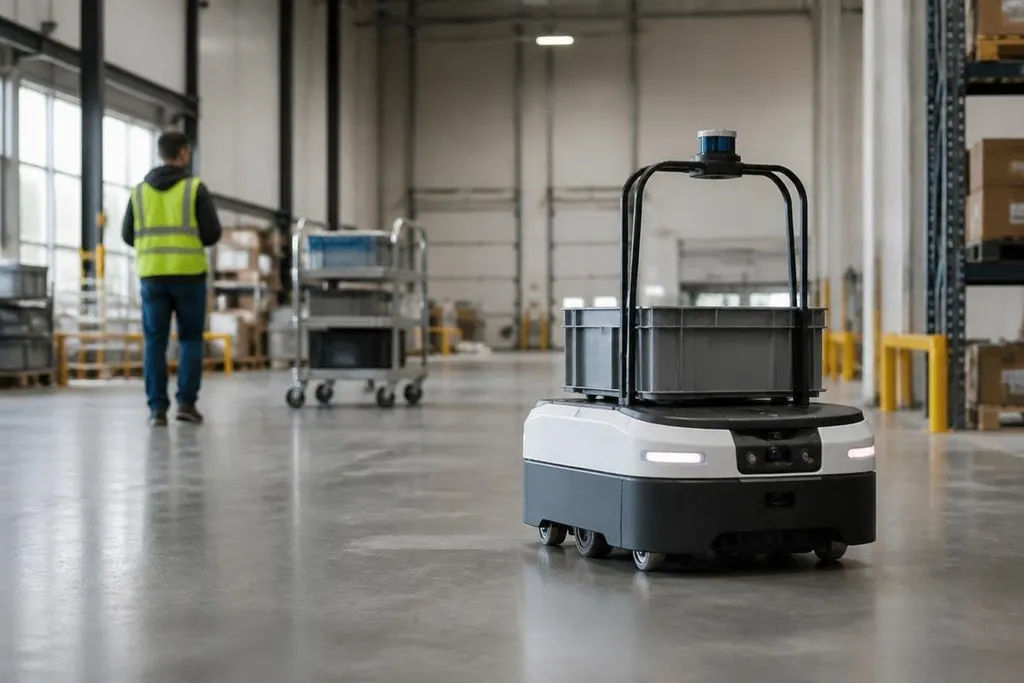
A mobile robot can map a site, carry goods, inspect equipment, or move through public spaces without a person steering every metre. The hard part is keeping those tasks safe and useful after the demonstration ends.
The companies building these systems are competing on more than speed. They need robots that can sense obstacles, plan routes, manage battery power, and recover when the site changes.
- Better sensing helps a robot handle people, shelves, doors, and uneven floors.
- Longer runtime cuts charging stops and keeps more units available.
- A useful system must fit the job, not only move well in a test area.
What a mobile robot must do
Most mobile robots combine a drive system, sensors, a computer, and software for movement. LiDAR measures distance with laser pulses, cameras help identify objects, and wheel encoders report how far the motors have turned. The robot combines these inputs to estimate its position.
That estimate matters because a map is only useful when the robot knows where it is on the map. A small error can grow near narrow aisles, ramps, glass doors, or busy crossings. Good movement software has to spot the error and correct the route without blocking people.
The task also changes the design. A warehouse robot may need a flat deck and a high payload. An inspection robot may need a camera mast, a gripper, or protection from dust and water. A delivery robot needs clear signals for people nearby and a way to stop safely.
Why the race is difficult
A robot that works in an empty test hall faces a limited problem. A working site adds loose packaging, changing light, temporary barriers, forklifts, pets, and people who do not follow the planned route.
Those conditions expose the gap between movement and useful work. Avoiding an obstacle still leaves a robot unable to reach the right shelf, pass a handoff to a person, or report a blocked route clearly.
Battery use adds another limit. Motors consume power while driving, but sensors, computers, radios, and lifting tools also draw energy. A company that reports travel distance without stating the payload, floor type, stop rate, and working time gives you little basis for comparison.
This is why uptime deserves more attention than top speed. A robot that moves quickly but spends long periods charging or waiting may complete fewer jobs per shift.
Where the evidence should come from
The strongest proof comes from a named deployment with a clear task, site, time period, and result. A video can show whether a route is uncut, whether a person steps in, and what happens after an error.
A product sheet can list payload, weight, speed, battery size, sensors, and protection rating, but it cannot prove that the robot handles a busy site.
That gap makes dated, named reporting useful. Robot24.com deployment reports put company claims beside the machine, site, task, and test result, so you can tell a live deployment from a controlled demo before you price the system.
Price also needs careful handling. The purchase figure may exclude software, site changes, charging equipment, service, training, and a person who handles exceptions. If a maker has not published a price, the honest answer is that the system cannot yet be compared on cost.
The open question is recovery. Nobody has shown that every mobile robot can handle the full mix of unusual events found in a busy workplace, so recovery time and human support belong in any serious trial.
A practical buying checklist
Use these points before you compare models or approve a pilot:
- Name the task: measure completed trips, inspections, picks, or handoffs rather than distance alone.
- Set the site limits: record floor surfaces, slopes, doors, lifts, lighting, people, and fixed obstacles.
- Measure working time: include charging, loading, route changes, safety stops, and operator help.
- Check the payload: weigh the full load, including bins, tools, batteries, and any attached equipment.
- Test recovery: block a route, move an object, stop the robot, and record how service resumes.
- Price the whole system: add software, installation, support, spare parts, and staff time.
A pilot should use the same measures from its first day to its last day. That makes it easier to see if the robot is doing useful work or if staff are quietly covering its weak points.
I'd judge a mobile robot by completed work during a normal shift, not by its fastest recorded run. The companies that can show that result, with the task, site, cost, and recovery data in view, will have the strongest case when the next buying decision arrives.